FTP and the Female Cyclist: What the Standard Training Numbers Get Wrong (Both Ways)
Most cyclists build their entire training around one number: FTP, functional threshold power and the percentage based zones that come off it. For a lot of riders that works well enough but the models underneath FTP and standard zone systems were built largely on male physiology, and recent research shows they miss two specific things about female cyclists, in opposite directions.
They overestimate how much power a woman can actually sustain at threshold. And they undersell how well she holds that power over a long ride. Neither shows up in a single FTP number. Here is what the data shows.
The standard approach overestimates women's sustainable power at threshold
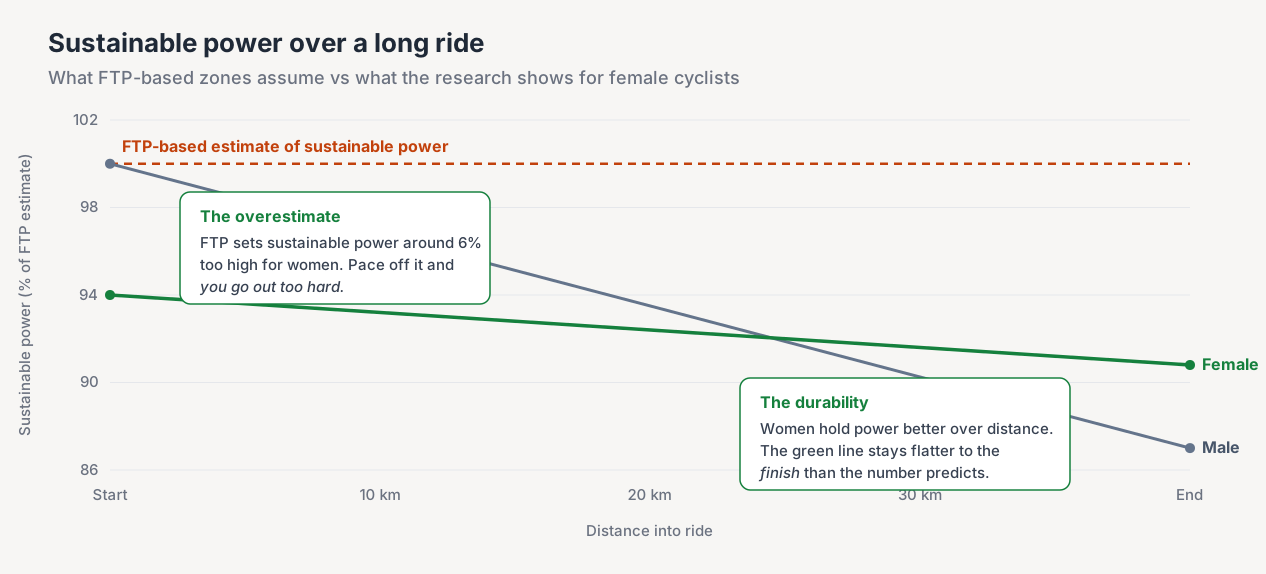
A study comparing the lactate threshold against actual 40 km time trial performance found that in women, power output at the second lactate threshold was 6 percent higher than the power they actually sustained across the time trial. In men, there was no significant difference.
Using the second threshold to set race or training intensity the standard way overestimates sustainable power for women, but not for men. A female cyclist who paces off that number is being told she can hold roughly 6 percent more than she actually can over the distance. On a 40 km effort that is the difference between a strong even ride and going out too hard and paying for it in the back third.
The authors of that study called explicitly for sex specific recommendations when using the second threshold to prescribe endurance intensity and race pace.
Over distance, women hold their power better than the number suggests
Women are, on average, more fatigue resistant than men in prolonged cycling. Research on durability after heavy intensity efforts found that women preserve the contractile function of their working muscles better than men over long constant load rides. In plain terms, deep into a long effort, a woman tends to hold on to her power better than a man who started at the same relative intensity.
Several physiological features drive this: greater reliance on fat oxidation, better preservation of glycogen stores, a higher proportion of fatigue resistant type I muscle fibres, and greater muscle perfusion. Muscle oxygenation studies show the same pattern from a different angle with women maintaining higher muscle oxygen saturation across a graded test while men rely more heavily on oxygen extraction at the same relative intensity.
This matters most where the efforts are longest. For endurance riding, gran fondos and the bike leg of a long course triathlon, durability is often what decides the day, not peak power. A female cyclist may hold her threshold deep into a long ride better than her FTP number, set by a short test, would ever suggest. The single number captures the top-end calibration problem and the durability advantage equally badly. It sees neither.
Why one number can't capture either
The reason FTP and percentage zones miss both of these is the same reason we keep coming back to across every sport we test: a single number derived from a population formula cannot describe an individual.
FTP is one value from one short test and the zones built off it are fixed percentages of that value. That system assumes your physiology sits at the population average in how your thresholds relate to your peak power, how your sustainable power relates to your threshold and how your fatigue resistance holds up over distance. For a female cyclist, the population those percentages were largely derived from was not hers.
The right way forward is not a better formula or a women's specific percentage chart because that just swaps one population average for another. The solution is measuring the individual directly. A lactate test finds where your aerobic and anaerobic thresholds actually sit, in power and heart rate, rather than estimating them from a percentage of a single number. It shows you your real sustainable intensity rather than a value set 6 percent too high and repeated over a training block it shows how your durability and thresholds are actually changing.
We wrote about the same principle in running in Your Zone 2 Heart Rate Is Probably Wrong. Here's How to Tell., and about how thresholds shift with training in How Quickly Can You Improve Your Lactate Threshold?. The sport changes. The problem with population formulas does not.
Measuring it directly
We are launching cycling lactate and VO2 testing at the end of August, adding power-based threshold testing to what we already do for runners. For a female cyclist that means your aerobic and anaerobic thresholds are measured in watts, your real sustainable intensity rather than an overestimate and the numbers to pace a long ride or a triathlon bike leg by your actual physiology rather than a formula built on someone else's.
We test at Team Rees in Caerphilly, KORE in Newport, UFit in Cardiff, Kulture in Bristol with Swansea coming soon. Cycling testing joins the lineup at the end of August.
Register your interest or book a current lactate threshold test here.
For more on why standard training zones mislead, read Your Zone 2 Heart Rate Is Probably Wrong. For what a lactate test report actually gives you, read What's Actually in a Lactate Threshold Test Report.
Ready to find your lactate threshold?
Book a test at one of our partner gyms and get a personalised training zone report.
Book a Test