How Quickly Can You Improve Your Lactate Threshold?
The honest answer is that it depends almost entirely on where you are starting from. An athlete returning from a layoff can move their threshold a long way in eight weeks. An athlete already near their ceiling might spend a season to gain a fraction of that. The number on its own means nothing without that context.
Here is a real example, with the before and after data, the training that produced it, and an honest breakdown of what you can expect depending on your own starting point.
Tayla's 8-week curve shift
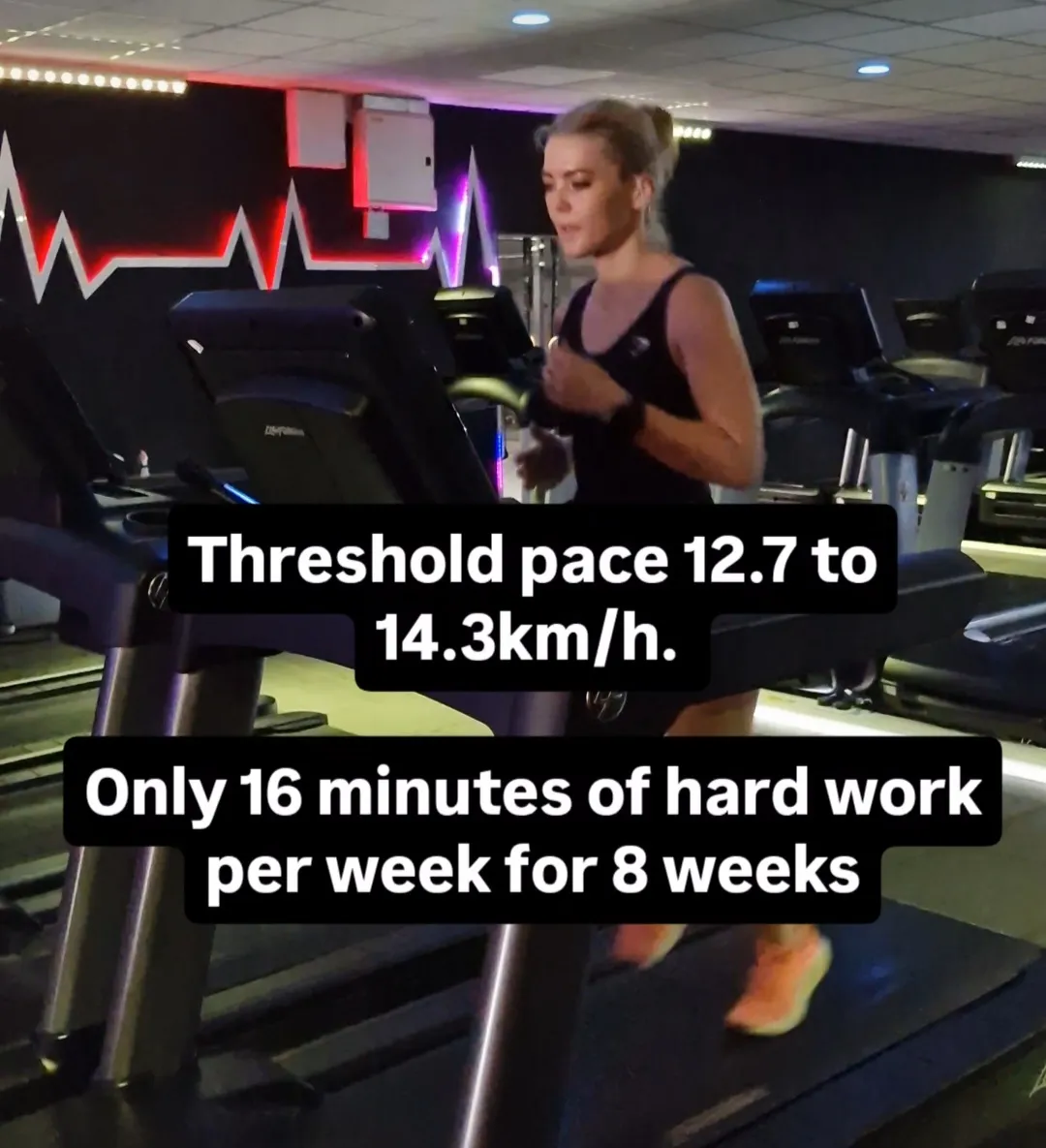
Tayla had an anaerobic threshold of 14.5 km/h before she picked up an injury. The time off (4 months) cost her. When we tested her on her return, her anaerobic threshold had dropped to 12.7 km/h. Detraining is fast and unforgiving and a layoff takes the sharpest edge of your fitness first.
We retested her eight weeks later. Her anaerobic threshold had climbed to 14.3 km/h, almost all the way back to her pre-injury number. Her aerobic threshold moved a small amount too, from 11.5 to 11.9 km/h.
On a lactate curve, this is a clear rightward shift. The whole curve moved right, meaning at any given running speed her blood lactate was lower than it had been eight weeks earlier. She was producing less lactate and clearing it more efficiently at the same paces. The speed at which she crossed each threshold moved up.
What actually drove it
Tayla did this with one structured intensity session per week.
The session was a Norwegian 4x4: four intervals of four minutes hard, each followed by four minutes of easy recovery. Sixteen minutes of actual hard work per session. The hard intervals were run at an intensity just above her anaerobic threshold, which is the zone that drives threshold adaptation most efficiently.
The rest of her week was easy aerobic running and her normal gym work. No other structured intensity. One session a week, sixteen minutes of hard running inside it, for eight weeks. That was the intervention.
The reason this worked so well is the reason I want to be honest about: Tayla was reclaiming fitness she recently had, not building it from scratch. Her body had been at 14.5 km/h a few months earlier. The neuromuscular and metabolic machinery was still partly there. Returning fitness comes back far faster than new fitness is built, because you are re-activating adaptations rather than creating them for the first time. This is well established and it is why detrained athletes improve so quickly when they return.
So how quickly can YOU improve?
Tayla's 1.6 km/h in eight weeks is not a universal expectation. It depends on your starting point.
If you are returning from a layoff or injury, like Tayla, you can expect fast gains. You are reclaiming recent fitness, and the curve can shift substantially in 8 to 12 weeks with consistent training. This is the fastest category of improvement.
If you are relatively new to structured training, you also have a lot of room. Athletes who have been training without a clear intensity structure often see large gains when they start training their thresholds properly. The first time you train an under-developed system, it responds quickly. Improvements of 5 to 10 percent in threshold pace over 12 weeks are realistic.
If you are well trained and near your ceiling, temper your expectations. A trained athlete who has been consistent for years might gain 1 to 3 percent over a similar period and that small gain is genuinely hard won. At this level the curve shifts slowly and every increment matters.
The pattern is the same one we saw when we tested an elite Hyrox athlete: the more developed your engine already is, the slower it changes. The athletes who improve fastest are the ones with the most to reclaim or the most untrained potential to unlock.
We covered what goes into a proper test in What's Actually in a Lactate Threshold Test Report.
Why retesting is valuable
A single lactate test tells you where you are today. A series of tests tells you whether your training is working. That is a fundamentally more valuable thing to know.
Without a retest you are guessing whether your training block did anything. You feel fitter but feeling fitter and being fitter are not the same and your watch cannot tell you which thresholds moved or by how much. A retest tells you whether the block worked, which threshold responded and whether your zones need recalibrating for the next block.
Tayla retests every 8 to 12 weeks for exactly this reason. Each test tells her whether the last block moved the needle and resets her training zones to her current physiology rather than her physiology from three months ago. As her thresholds change, we recalibrate her watch to match, the way we covered in our post on setting your watch zones from a lactate test.
The athletes who get the most from testing are the ones who test, train against the data, retest, and adjust. The data compounds.
Test, train, retest in South Wales
We test athletes at Team Rees in Caerphilly and KORE in Newport. Cardiff is 20 minutes from either.
Book a lactate threshold test at Team Rees, Caerphilly, or KORE, Newport.
For more on the testing itself, read Do You Actually Need a Lactate Threshold Test?. For what an elite engine looks like, read What an Elite Hyrox Athlete's Lactate Profile Actually Looks Like.
Ready to find your lactate threshold?
Book a test at one of our partner gyms and get a personalised training zone report.
Book a Test