Lactate vs Ventilatory Thresholds: Our Findings and Why We Measure Blood, Not Breath
There are two lab methods for finding your training thresholds. You can measure blood lactate directly, or you can estimate the thresholds from your breathing using gas exchange, which gives you what are called ventilatory thresholds. Both are considered laboratory-grade methods. Both usually agree.
But usually is not good enough when you are prescribing one athlete's exact training pace. In our testing we regularly see the two methods diverge by around 0.5 km/h, and at that point the question stops being academic. That margin is the difference between a target of 5:00 per km and 4:45 per km. For a single athlete trying to train and race at the right intensity, that is too far off to accept. Here is why we measure blood lactate for thresholds, and why we still rate gas exchange highly for the things it measures best.
The two methods measure different things
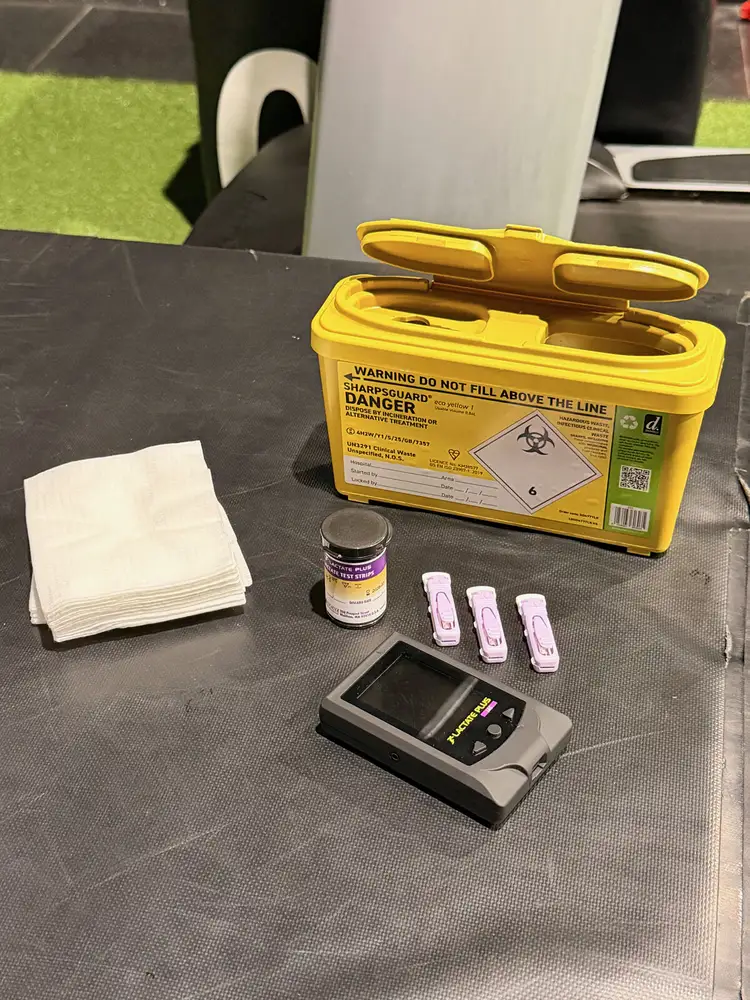
Blood lactate testing measures the metabolite directly. We take a small sample from the earlobe at each stage of a graded test and read the actual lactate concentration in the blood. The thresholds are the points where that concentration changes behaviour: the first rise above baseline (aerobic threshold) and the point where it starts accumulating faster than the body can clear it (anaerobic threshold). You are measuring the thing itself.
Ventilatory thresholds are derived from your breathing. As exercise gets harder and lactate rises, your body produces more carbon dioxide and your breathing changes in response. Gas exchange analysis tracks the air you breathe in and out and looks for the points where ventilation breaks away from oxygen uptake. Those breakpoints are the ventilatory thresholds.
The difference matters. Blood lactate is the direct measurement. The ventilatory threshold is the breathing system's response to the consequences of rising lactate, which is a few steps further down the metabolic chain. You are not measuring the event. You are measuring the echo of the event.
Why ventilatory thresholds carry more error
Three things make the ventilatory method less precise for an individual.
First, it is indirect. Breathing responds to rising carbon dioxide, which itself follows from rising lactate. Each step in that chain adds a little slack between what is actually happening in the muscle and what shows up at the mouth.
Second, the breakpoint is identified subjectively. There is no single objective number. An assessor reads the gas exchange curves and visually identifies where ventilation breaks away from oxygen uptake. Different assessors, and different detection methods, can place that breakpoint in different spots on the same data. The literature on ventilatory threshold detection openly describes it as a subjective judgement.
Third, breathing patterns vary between people. Not everyone's ventilation breaks cleanly at the threshold. Studies looking at breathing patterns at the breakpoint have found that a substantial share of people show one kind of response and the rest show another, which means the curve you are reading does not always have an obvious corner to identify.
Blood lactate sidesteps all three. The number is the number. With a good protocol and a proper curve fit, the inflection points are objective and reproducible. You are not interpreting a breathing pattern. You are reading a measured concentration.
What 0.5 km/h actually costs
Half a kilometre per hour sounds trivial. In the context of a single athlete's training prescription it is not.
At a target pace of 5:00 per km, a 0.5 km/h error shifts your prescribed pace to roughly 4:45 per km. Fifteen seconds per kilometre. Over a 10 km race that is two and a half minutes. Over a marathon it is more than ten. If we hand an athlete a threshold pace that is 15 seconds per km too fast, every threshold session they run off that number is run too hard, and every race they pace off it risks blowing up in exactly the way we spend so much effort helping athletes avoid.
The entire value of a threshold test is the precision of the number it gives you. A threshold pace that is in the right area but not exactly right is a threshold pace you cannot fully trust, and an athlete who cannot fully trust their number is back to training on feel. We are not willing to hand over a number with that much slack in it when a more direct measurement is available. So we measure blood.
Where gas exchange genuinely wins
None of this means gas exchange is a worse technology. It means it is the wrong tool for finding thresholds specifically. For other measurements, it is the right tool and we rate it highly.
Gas exchange is the direct, gold standard way to measure VO2 max, your maximal oxygen uptake and the ceiling on your aerobic engine. It is also how you measure running economy, how efficiently you use oxygen at a given pace, which is one of the most useful and least understood performance metrics in endurance sport. And it is how you measure resting metabolic rate, the number of calories your body burns at rest, which has real value for fuelling and body composition.
These are things blood lactate cannot tell you, and things gas exchange measures directly and well. So the honest position is not lactate good, gas bad. It is: use each tool for what it measures directly. Blood lactate for thresholds. Gas exchange for VO2 max, running economy and resting metabolic rate.
We are adding VO2 max, running economy and resting metabolic rate testing soon, measured by gas exchange, alongside our blood lactate threshold testing. Thresholds from blood, ceiling and efficiency and metabolism from breath, each measured the most direct way we can.
The hierarchy of threshold methods
To put ventilatory thresholds in context, here is roughly how the methods for finding your thresholds rank for accuracy.
At the top is direct blood lactate measurement. You measure the metabolite, the inflection points are objective, and with a good protocol it is the most reproducible number you can get for an individual.
A step down are field tests like a 30 minute time trial, critical speed, or a cycling FTP test. These are genuinely useful and accessible, and far better than a formula, but they estimate a single threshold from a sustained effort rather than measuring the full curve, and they are affected by pacing, motivation and conditions on the day.
At the bottom are formulas and watch estimates: 220 minus age, percentage of max heart rate, 5 km time calculators, and your watch's automatic threshold guess. These are population averages applied to an individual, and they can be wildly off. We have written about how wrong they can be in Your Zone 2 Heart Rate Is Probably Wrong and why your Garmin heart rate zones are likely off.
Ventilatory thresholds sit near the top of that list. They are a legitimate laboratory method. They are simply less direct and less reproducible for an individual than measuring blood lactate, and the half a kilometre per hour of slack we see is more than we are willing to build a training prescription on.
How we test
We measure thresholds from blood lactate at Team Rees in Caerphilly and KORE in Newport. Cardiff is 20 minutes from either. Each test gives you your aerobic and anaerobic thresholds in km/h, your training zones, and your watch recalibrated before you leave. VO2 max, running economy and resting metabolic rate testing by gas exchange are coming soon.
Book a lactate threshold test at Team Rees, Caerphilly, or KORE, Newport.
For more on why your watch and the standard formulas get your thresholds wrong, read Your Zone 2 Heart Rate Is Probably Wrong and What's Actually in a Lactate Threshold Test Report.
Ready to find your lactate threshold?
Book a test at one of our partner gyms and get a personalised training zone report.
Book a Test