Do You Actually Need a Lactate Threshold Test? An Honest Answer
Most athletes who book a lactate threshold test benefit from it. Some don't.
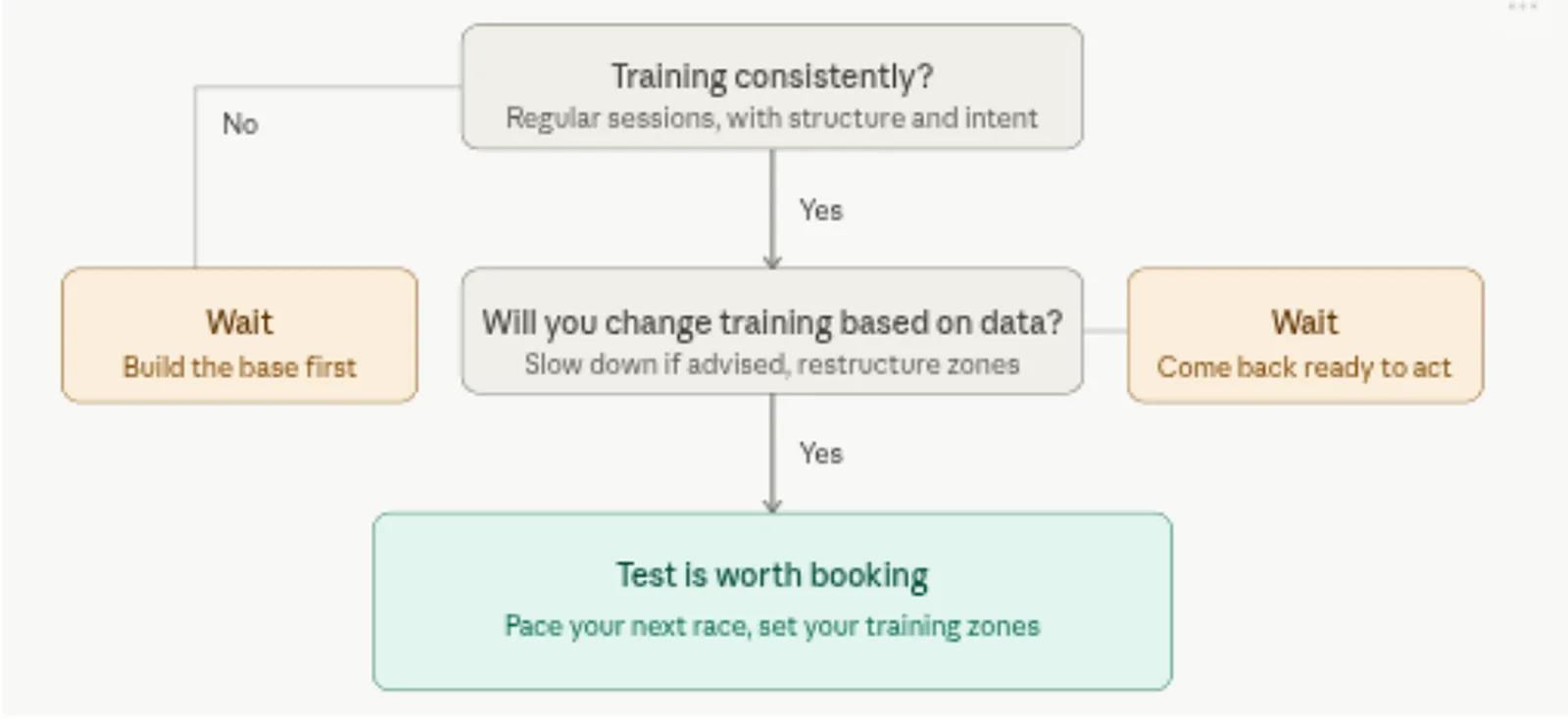
The difference comes down to two things: whether you train consistently enough for the result to be meaningful and whether you'll actually change your training based on the data. If either of those is missing, the test is a waste of money.
Who genuinely benefits from a lactate threshold test
Five athletes book this test most often, and walk away with the most useful data:
The athlete with a planned race. From a test, we can derive your target race paces and zones built on your actual physiology, not the population average estimates your watch is using. More importantly, it shows you where your thresholds sit, meaning you can use them tactically. You know which efforts you can sustain, which efforts will cost you, and at what point you tip from one to the other. Race plans built on that data are decisions, race plans built on feel are guesses.
Ideally you'd test 8 to 12 weeks out which gives you time to train on the data and let the new zones become familiar before race day. But closer still works. A test three weeks out still beats racing on guesswork. A test two weeks out is more useful than no test at all. The test itself is a hard effort but it isn't high volume so recovery is fast and you're not eating into your taper the way a long session would. The only window we'd push back on is race week itself and even then only because the conversion from data to confident execution gets harder the closer you are to the start line.
The athlete who's plateaued and doesn't know why. If your weekly mileage has gone up but your race times haven't, the test usually shows the same pattern: an LT2 (what is often referred to as 'threshold') that hasn't shifted because you've been training the wrong system. Most plateaued runners are spending too much time at moderate intensity. Hard enough to feel like work and fatigue but not hard enough to drive adaptation. The data shows the gap between where you are and where you should be training.
The athlete coming back from a break. Whether it's injury, illness or life, you've lost fitness and you don't know how much. Old heart rate zones won't fit anymore. The test gives you accurate zones for the body you have right now which means the rebuild is built on data, not on what your watch remembers.
The athlete whose watch zones feel obviously wrong. If your easy runs leave you exhausted or your tempo runs feel too easy, the age based formula your watch uses is probably wrong for you.
The Hyrox athlete who blows up in the second half. This is so common it deserves its own line. The pattern in the data is almost always the same: a strong aerobic engine compromised by stations that push you above LT2, with poor lactate clearance meaning you can't recover between efforts. Once you know your numbers, you can pace the run segments to stay below threshold and treat the stations as the lactate spikes they actually are. (More on this in Why You Blow Up in the Second Half of a Hyrox.)
Who shouldn't bother, at least not yet
There are four categories of athletes who book lactate tests and don't get their money's worth.
Beginners in their first 6 to 12 months of structured training. Your numbers will change too fast for the data to stay accurate. LT1 (the 'first aerobic threshold') and LT2 shift meaningfully in the first year as your aerobic base develops. Build the base first. Test once you're stable.
Athletes who won't actually change their training. This is the most important one and the hardest to admit. If your plan is fixed because your coach has set it or because you've always trained this way the data is simply expensive curiosity. The most common version of this is the athlete who tests, learns their easy pace should be slower than what they currently run, and then keeps running it the old way because the slower pace feels too easy.
Athletes whose primary goal is body composition, not performance. Lactate threshold testing is a performance test. It tells you how to train for endurance outcomes, race times, sustainable power, aerobic efficiency. It doesn't tell you anything useful about fat loss or muscle gain.
Athletes who tested in the last 12 weeks without completing a training block. The whole point of a second test is to measure what a structured block has changed. Wait until there's something to measure.
What changes when the answer is yes
You walk away with three things.
The first is a set of training zones built on your physiology. Actual heart rates and paces tied to LT1 and LT2, not estimates from a watch algorithm. Most athletes find at least one of their watch zones is off by 15 to 20bpm, some are off by even more. Training in the right zones means your easy runs build aerobic capacity instead of accumulating fatigue and your hard sessions actually push the system you're trying to develop.
The second is a pacing strategy for your next race. If, for example, LT2 sits at 4:40/km and 168bpm, you know what your sustainable race pace looks like and you know exactly what happens if you go out at 4:30 in kilometre one. We've watched athletes take five minutes off a Hyrox PB by pacing the run segments two seconds per kilometre slower in the first half.
The third is a benchmark to retest against. A second test 12 to 16 weeks later shows you whether the training block actually shifted your physiology. If your zones have moved up, the block worked. If it hasn't, something in the plan needs to change. Most athletes we test once test again because they want to know if they're getting better and "I think I am" stops being good enough at a certain level of seriousness.
Still not sure?
Two options. Read What's Actually in a Lactate Threshold Test Report, it walks through a real anonymised report so you can see exactly what you'd be paying for before deciding. Or send us a message describing your situation. If testing isn't right for you yet, we'll tell you.
We test athletes from across South Wales at Team Rees in Caerphilly. Book a session here when you're ready.
Ready to find your lactate threshold?
Book a test at one of our partner gyms and get a personalised training zone report.
Book a Test