
What an Elite Hyrox Athlete's Lactate Profile Actually Looks Like
This week we tested Bodger Rees, a Hyrox Pro with 12 podium finishes and a 57 minute race time, at KORE gym in Newport. He is the founder of KORE, Newport's HYROX-only training facility, and one of the strongest Hyrox athletes in Wales.
We are not going to publish his exact numbers. At his level that is competitive intelligence. A rival who knew Bodger's exact figures could reverse engineer his pacing strategy and train specifically to beat it. So the precise values stay between us and him.
The shape of an elite Hyrox lactate profile is one of the most instructive things a recreational athlete can learn from, and we can share that. Here is what separates a professional Hyrox engine from a good recreational one, illustrated by the difference between Bodger and the recreational athletes we have tested.
The single biggest difference is an enormous aerobic base
The defining feature of Bodger's profile is how low his blood lactate stayed across an extremely wide range of running speeds. Paces that would have a recreational athlete deep into lactate accumulation barely moved his numbers.
This is a sign of years of consistent aerobic training. You cannot shortcut it and you cannot build it in a single training block. It is the accumulated product of a large volume of aerobic work, repeated over years, that has expanded his ability to produce energy aerobically and clear lactate efficiently.
For Hyrox specifically, this is the trait that matters most. We covered in our Hyrox pacing post that the stations repeatedly push your system above your anaerobic threshold, and the running segments are your only chance to clear the lactate they generate. An athlete with a huge aerobic base clears that lactate faster, recovers between stations more completely and arrives at the back half of the race with less accumulated fatigue. Bodger's profile is built for exactly this demand.
Elite versus recreational: a side-by-side comparison
To make this concrete, compare Bodger's profile with two recreational athletes we have tested (anonymised).
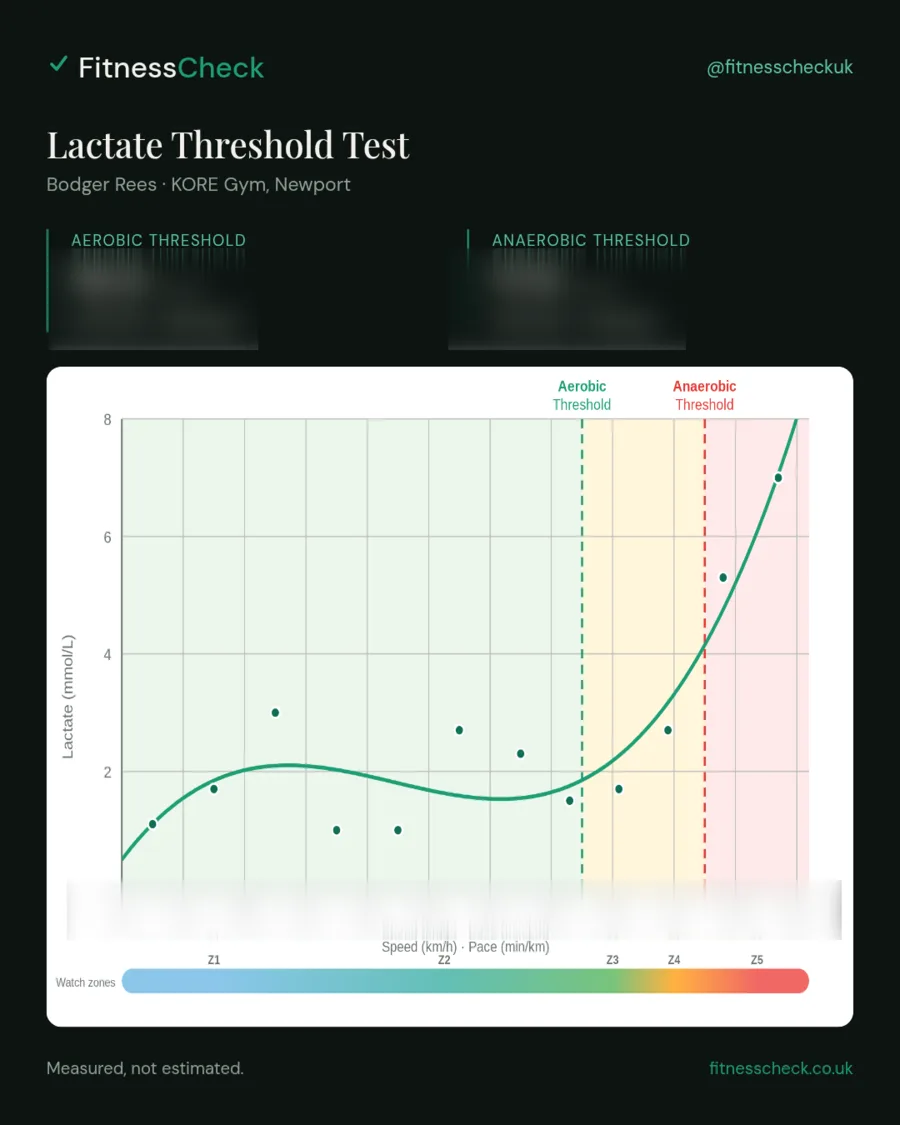
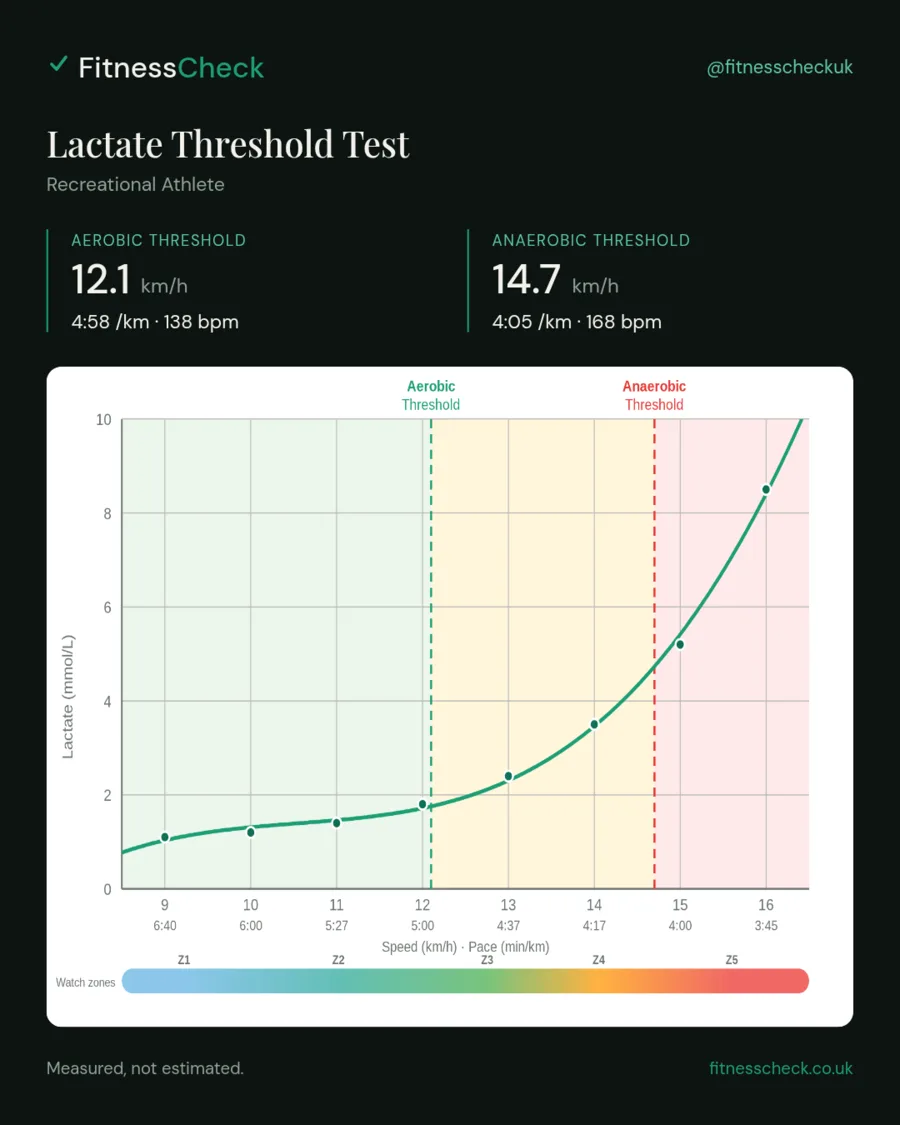
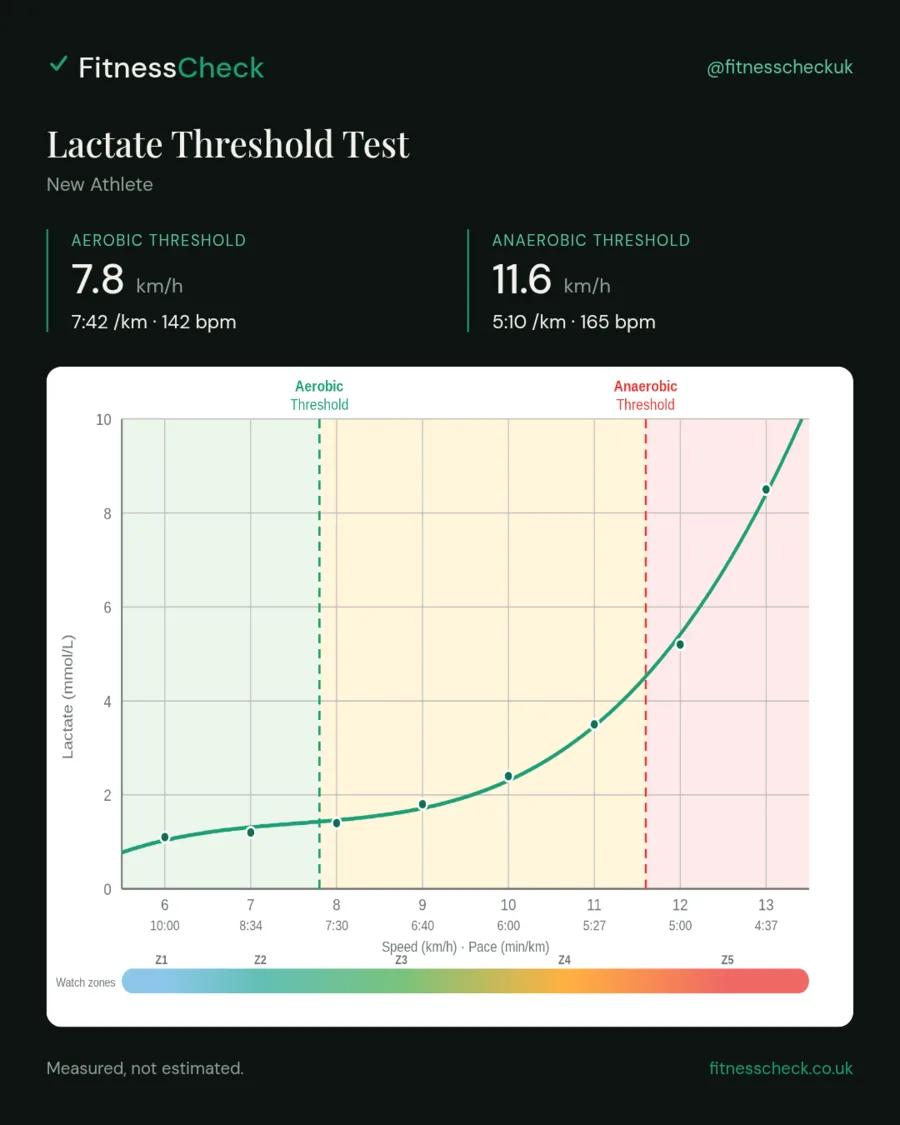
The pro (Bodger). Lactate stays low across a very wide range of speeds. Anaerobic threshold very high. Aerobic threshold exceptionally high, sitting close beneath it. Clears lactate fast. Built by years of consistent aerobic volume. Can race close to his anaerobic threshold because his aerobic threshold is nearly there too.
A strong recreational athlete (sub-70 minute finisher). Anaerobic threshold around 14.7 km/h, a genuinely good number. But his aerobic threshold sits well below it, with a wide zone in between, and his lactate climbs more steeply once he passes the aerobic threshold. He can race reasonably close to his anaerobic threshold because his race is short enough, but he has to back off hard after the sled push to repay the oxygen debt.
A newer recreational athlete (around 90 minute finisher). Anaerobic threshold around 11.6 km/h. Her aerobic threshold sits lower still relative to her anaerobic one, and because her race takes 90 minutes, lactate has far more time to accumulate across the duration. She needs to run well below her anaerobic threshold for most of the race, closer to her aerobic threshold, to avoid catastrophic accumulation.
The pattern across all three: the more developed the aerobic base, the higher the aerobic threshold climbs, and the closer to anaerobic threshold the athlete can race. Bodger sits at the far end of that spectrum because of how long he has been building his engine.
What recreational athletes should take from this
The temptation, looking at an elite profile, is to train like the elite athlete. That is the wrong lesson. Bodger did not get his profile from doing Bodger's current training. He got it from years of consistent aerobic volume, accumulated long before he was racing at the front.
The lesson for a recreational athlete is the opposite of intensity. It is patience with the aerobic base. The thing that separates the pro is not a clever interval session or a magic threshold workout. It is the slow, unglamorous accumulation of aerobic training that pushes your aerobic threshold higher year on year.
That is also why testing matters more than guessing. Your aerobic and anaerobic thresholds are the two numbers that tell you whether your base is actually developing or whether you are stuck training hard without building the engine. We covered this in our Zone 2 post. Most athletes who think they are doing aerobic base work are training above their aerobic threshold without knowing it, which is exactly the mistake that stops the base from developing.
Get tested where the pros do
Bodger was tested at KORE, his HYROX specific facility in Newport, and you can book the same test there. We also test at Team Rees in Caerphilly. Cardiff is 20 minutes from either. Both give you your aerobic and anaerobic thresholds in km/h and allow you to recalibrate your watch.
If you are racing the autumn season, the time to test is now. Three months gives you enough runway to find your real thresholds, train your aerobic base against them and build the engine that every elite profile is made of.
Book a lactate threshold test at KORE, Newport, or Team Rees, Caerphilly.
For the pacing strategy that uses these numbers, read our Hyrox pacing post. For more on why generic zones mislead, read Why You Blow Up in the Second Half of a Hyrox.
Ready to find your lactate threshold?
Book a test at one of our partner gyms and get a personalised training zone report.
Book a Test